


How has the COVID-19 pandemic impacted the polyurethane industry?
Release time:
15 Feb,2020
At the beginning of 2020, Wuhan was put on pause, and China as a whole was slowed down. The sudden outbreak of COVID-19 profoundly impacted society and the economy. As one of the industrial sectors, the polyurethane industry was also deeply affected and severely wounded by the sudden onset of COVID-19, which had a profound impact on both society and the economy.
Impact on production
To effectively prevent and control the spread of the epidemic, the national government and many provincial and municipal authorities have issued notices postponing the resumption of work for enterprises. Generally speaking, the resumption of work in various regions should not occur before 24:00 on February 9. Among them, Hubei Province has stipulated that all types of enterprises may not resume work before 24:00 on February 13, while certain areas in Guangdong Province have set the resumption date for enterprises after March 1. Bulk raw materials such as MDI, TDI, and polyether are produced using continuous industrial-scale facilities. Some of these facilities were scheduled to shut down before the Spring Festival and restart in early February; however, due to the impact of the epidemic, their restart dates have now been postponed. As for facilities currently in normal operation, their production loads have also been reduced because the epidemic has disrupted product transportation and weakened downstream demand.
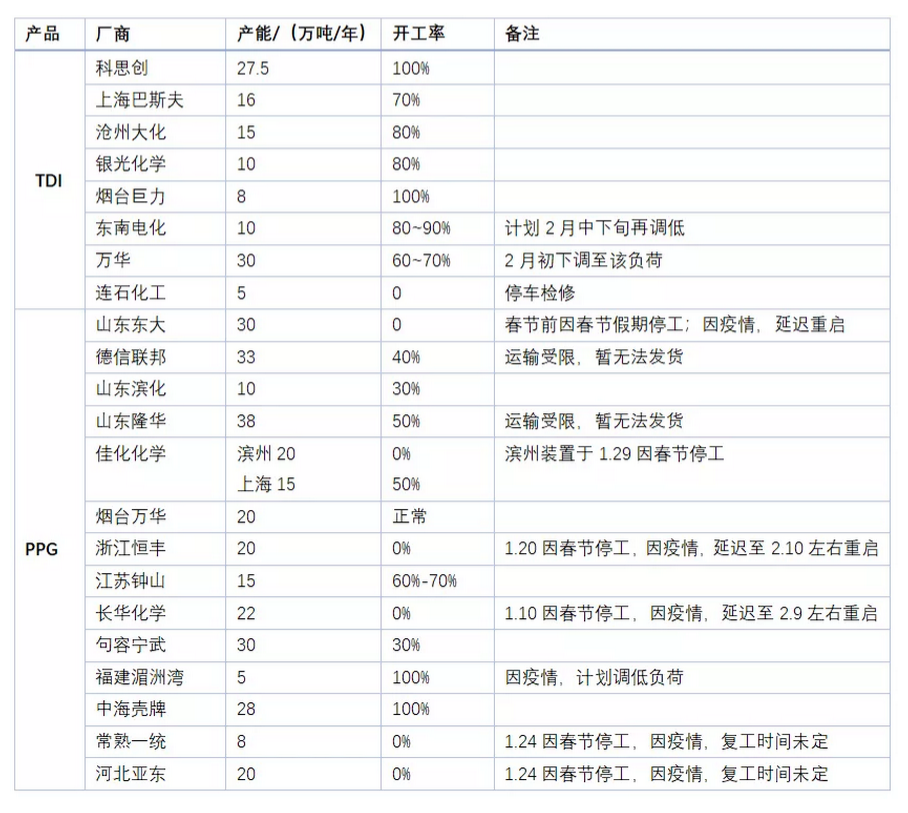
Polyurethane products such as downstream soft foams, rigid foams, shoe soles, slurry, and CASE materials are produced using a batch process. Under normal circumstances, production would come to a halt during the Spring Festival holiday. However, due to epidemic prevention measures, the shutdown period will be longer than in previous years, and the timing of resuming production remains uncertain.
There are a large number of polyurethane product enterprises. While a small number of major downstream manufacturers procure raw materials directly from raw-material suppliers, more than 80% of small and medium-sized enterprises rely on agents and traders for their raw-material purchases. Normally, raw-material inventories last for one to two weeks. Following the resumption of work, these enterprises will face new procurement needs and fresh logistics and transportation arrangements. Currently, logistics and transportation have slowed down, and logistics costs have risen. If raw materials cannot be replenished in a timely manner after work resumes, safety stock levels will quickly become critical, and plant operating rates will remain low.
Impact on the downstream market
From 2018 to 2019, the real estate market slowed down, and a large amount of production capacity for sofas, mattresses, and other furniture items shifted to Southeast Asia, leading to sluggish performance in China’s upholstered furniture industry. According to data from Tiantian Chemical Network, in 2018, the polyurethane flexible foam consumption in the upholstered furniture sector reached a historical high of 1.35 million tons; however, in 2019, total consumption fell to 1.3 million tons, marking the first-ever decline. This year, the process of capacity relocation will continue. Moreover, due to the pandemic, shopping malls remain closed, and people have reduced their outings for purchases, further driving down the upholstered furniture industry’s demand for polyurethane flexible foam compared to 2019 levels. On the other hand, the production capacity relocated to Southeast Asia has not been affected by the COVID-19 pandemic, and exports from Southeast Asia to Europe and the U.S. will proceed as usual. This development is beneficial for multinational upholstered furniture manufacturers and polyurethane foam sponge producers that have established operations in multiple regions.
Cars are high-priced consumer goods. The pandemic has brought many industries to a standstill, leaving business owners facing daily losses and ordinary salaried workers grappling with declining incomes. This is bound to lead to a reduction in automobile consumption. In 2020, automobile production and sales volumes may slightly decline compared to 2019, which will in turn result in a drop in the demand for polyurethane used in automotive applications.
In addition to supplying the domestic market of 1.4 billion people, Chinese manufacturers of footwear and apparel also export large quantities overseas. The end of December and the period before the Spring Festival represent the peak season for footwear and apparel sales. At that time, except in the Wuhan area, epidemic prevention and control measures had not yet been implemented nationwide, so sales were not yet affected. After the Spring Festival, shopping malls across China delayed their reopening, and during the Golden Week holiday, citizens were unable to go out and spend money, causing footwear and apparel sales to virtually come to a standstill. On the export front, on January 30, the World Health Organization declared the COVID-19 outbreak a Public Health Emergency of International Concern. Beyond WHO’s requirements, some countries have taken measures such as suspending or reducing flights to and from China and halting visa issuance. As a result, exporters are facing reduced or postponed foreign orders. Consequently, domestic demand for raw materials such as sole compounds and pastes has also essentially stalled. A sole compound and paste manufacturer in Shandong stated: “We have no plans to resume work in February, and when we’ll start production in March depends on the epidemic situation and market conditions.” On the other hand, spandex—a type of elastic fiber—is widely used in medical fields such as mask ear loops and medical protective clothing. With the sharp increase in demand for medical protective supplies, spandex factories have ramped up production to full capacity. As workers gradually return to work, the overall operating rate of spandex factories will continue to rise.
The impact on prices
Due to transportation disruptions and the failure of downstream manufacturers to resume operations, market trading activity has become very sparse. Most intermediaries are working from home, and sporadic quotes are being submitted at prices that remain largely unchanged from pre-Spring Festival levels.
China exports certain amounts of MDI, TDI, and PPG, especially PPG. In 2019, China’s annual PPG exports reached nearly 600,000 tons. At present, Chinese PPG manufacturers are operating at low capacity utilization rates, and transportation disruptions have led to a significant decline in China’s PPG exports. According to market reports, polyether products from Southeast Asia are currently in short supply due to the absence of Chinese exports, resulting in rising prices.


Quick Navigation
Contact Us
No. 428, Jinbai Road, Jinshan Industrial Zone, Shanghai, China

WeChat Video Channels

WeChat Official Account

TikTok account