


The excellent performance of TPU will significantly boost its applications in the automotive sector.
Release time:
11 Apr,2018
In the era of automotive lightweighting, material design has become a key research topic in the industry. In addition to the extensive use of plastics such as PP, PVC, PU, and PA, reinforcing materials like carbon fiber and glass fiber have also emerged as hot research areas attracting significant market attention in the age of automotive lightweighting. With the technological advancements in thermoplastic elastomer products, their applications in the automotive sector are becoming increasingly widespread. Currently, commonly used thermoplastic elastomers in automobiles include polyolefin-based types (TPO, TPV), polyester-based types (TPEE), polyurethane-based types (TPU), and styrene-based types (TPS).
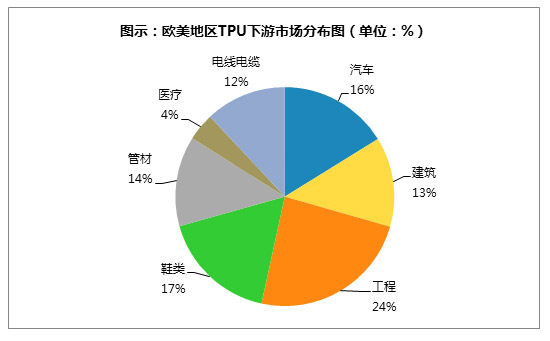
Distribution Map of Downstream TPU Markets in Europe
The TPU boasts outstanding wear resistance, resistance to bending fatigue, and high elasticity, making it suitable for a wide range of automotive components, such as shift lever handles, bushings and washers for various couplings, connectors for different wire harnesses, spiral retractable cables, cable jackets, toothed belts, sheaths and gaskets for steering tie rods, suspension joint hinges, hydraulic and pneumatic components, suspension diaphragms, shock-absorbing diaphragms, shock absorbers, spring limiters, and more. It can also be compounded with other plastics or rubbers for use in automotive parts like bumpers, airbags, and dust covers.
From a global application perspective, TPU products in Europe and the U.S. started developing earlier and have reached a relatively mature technological stage, with wider applications in high-end markets. Currently, TPU applications in the automotive sector already account for over 15% of the total. In contrast, in the Asia-Pacific region, TPU products are still primarily used in low-end footwear materials, with automotive applications accounting for less than 10%. Although the share of TPU applications in footwear has slightly declined in China, growth in the automotive sector remains below 5%, and most of these applications still rely on imported products or those from foreign-invested enterprises, leaving considerable room for further development.
The applications of TPUs in the automotive sector can take the following forms:
(1) TPU/PP plastic alloy
This material boasts advantages such as being lightweight, cost-effective, and recyclable, and is expected to be widely used in automotive interior and exterior components, including bumpers and their brackets, as well as various vehicle-mounted brackets and structural frames.
(2) TPU/PC plastic alloy
Blending TPU with PC can improve PC’s toughness, resistance to stress cracking, notch sensitivity, solvent resistance, and chemical resistance. At the same time, it can lower the molding and processing temperature of PC, thereby expanding its application scope in the automotive industry.
(3) TPU/PVC plastic alloy
The TPU/PVC alloy can significantly improve the elongation at break of PVC and greatly enhance its environmental friendliness. It reduces the harm caused by plasticizers in PVC to both the environment and human health, thereby expanding the application scope of PVC.
(4) TPU/PA6 plastic alloy
The blending of TPU and PA6 not only retains TPU’s high elasticity, high strength, and wear resistance but also enhances its temperature resistance. With its outstanding overall performance, this new high-performance composite material holds great application potential in the automotive industry.
(5) TPU long-fiber composite material
Long-fiber-reinforced thermoplastic composites (LFT) exhibit excellent properties such as high strength, high rigidity, excellent dimensional stability, low warpage, long service life, and creep resistance, and have thus been widely adopted in the automotive industry. Among these, TPU (alloy)/LFT composites can be extensively used in automotive dashboards, bumpers, floor panels, front-end and door components, as well as underbody protection systems.
In summary, TPU has a wide range of applications in the automotive industry, and its outstanding performance makes it an important pathway for achieving vehicle lightweighting. Currently, China's TPU industry is developing rapidly, with new products being continuously introduced and high-end applications gradually expanding. We believe that TPU’s application in the automotive sector will see a significant boost in the future.


Quick Navigation
Contact Us
No. 428, Jinbai Road, Jinshan Industrial Zone, Shanghai, China

WeChat Video Channels

WeChat Official Account

TikTok account